Chapter XIV: Abbots Henry Crichton and George Schaw, 1459—1498
The great families represented by the above-mentioned lords were good friends to the Abbey; but Abbot Shaw had a greater friend in the King, with whom it was better worth his while to keep on good terms. There is little doubt that he sent the King both the workmen and “shools.”
Abbot Shaw was one of the three churchmen[28] commissioned by Pope Innocent the VIII. to absolve all those concerned in the insurrection against the late King, and to restore them to the communion of the faithful after prescribing them salutary penance. King James IV. bitterly repented the share he had in his father's death. He inflicted severe penances on himself and made many pilgrimages to sacred shrines to atone for his guilt. The Bull of the Pope directed to Abbot Shaw was dated in July, 1491, and in the month of November in that year the King presented himself at the Abbey. He had been on a pilgrimage to the shrine of St. Ninian at Whithorn, and now he came to the Abbot to receive the absolution that father was commissioned to bestow.[29]
The Abbot had a grievance, which was doubtless related in due form to the Royal visitor. The old contentions as to the Argyleshire churches belonging to the Convent were revived. Robert, the Bishop of Lismore, sequestered the revenues of three of these churches,—Colmanell, Kylkeran, and Killelan.[30] The Abbot appealed to the curators of the privileges of Clugny appointed by the Pope, and they put into operation the full powers of the law against the rapacious prelate. Alexander Clugston, the notary public belonging to the Abbey, first warned the bishop, whom he found in the town of Dunbarton, of their orders, and finally, on their authority, pronounced sentence of excommunication against him in the cathedral of Glasgow. The Highland Bishop, however, still kept firm hold of the churches, defying even the decision of the Pope. All this would be doubtless told to the King, and not without good result, for shortly after he put the Bishop's successor above the temptation to attack the churches appropriated to Paisley, by bestowing some more churches on the bishopric, assigning as a reason for his bounty the poverty of the See, “situated among wild and untameable tribes.”[31]
When the King visited Paisley, he found a scene of bustle and activity around the Convent. The Abbot was engaged in adding to the buildings, and the King visited the works, and gave drink money to the men. In the treasurer's book appears this notice,—“Item, 21 Novembris, to the Masonis of Pasla . . xs.”[32] Abbot Shaw, in his time, improved greatly the surroundings of the Abbey. He built a refectory and other conventual buildings, and reared a lofty tower over the principal gate; he also enclosed the church, the precincts of the convent, the gardens, and a little park for deer, within a wall about a mile in circuit.[33] The wall is spoken of with admiration by those who were privileged to see it. Bishop Lesley grows eloquent as he describes its magnificence, its four-sided beautiful stones, and the lofty statues by which it was adorned. On the middle of the wall, to the north side, he caused place three different shields,—the royal arms in the middle, the arms of the founder, the great Stewart of Scotland, a fess cheque, on the right side, and his own on the left. There are niches at the angles of the wall of most curious graved work, in one of them there was a statue of St. James the apostle, the patron of the Abbacy; in another, an image of the blessed Virgin, with this distich near it, but somewhat more inward:—
Hac ne vade via nisi dixeris Ave Maria,
Sit semper sine via, qui non tibi dicet Ave. [34]
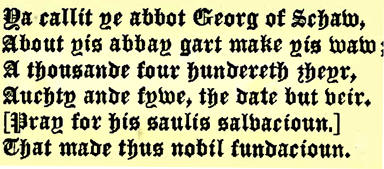
Of this wall, that called forth such rapturous description, but very few fragments indeed remain.[35] The statues that adorned it have all disappeared, but there are still two tablets that belonged to it. The one is the Royal Arms of Scotland, mentioned in the description we have quoted, and the other is an inscription by the pious builder himself.[36]
[37]
[28] See Bull appended to Thomas Innes' Scotland. The other two to whom the Bull was addressed were the Abbot of Jedburgh and the Chancellor of Glasgow.
[29] Chamberlain Accounts.
[30] Reg. de Pas., p. 154.
[31] Historical Accounts of the Priory of Beauly, by P. C. Batten, p. 152.
[32] Chamberlain Accounts.
[33] I give these particulars on the authority of Crawfurd, in his “Officers of State.” He wrote in 1726, and so probably saw something of the splendour of which he speaks.
[34] “Go not this way unless you have said Ave Maria. Let him be always a wanderer who will not say Ave to thee.”
[35] Part of the wall can be seen on the east and west sides of the north end of the Abbey Bridge.
[36] The first tablet was built in the wall of a house in Incle Street, and the second in a house in Lawn Street. They are to be placed for preservation in a more suitable situation.
[37] The fifth line of this inscription has been chiseled off.